Showing posts with label fujifilm reala 100. Show all posts
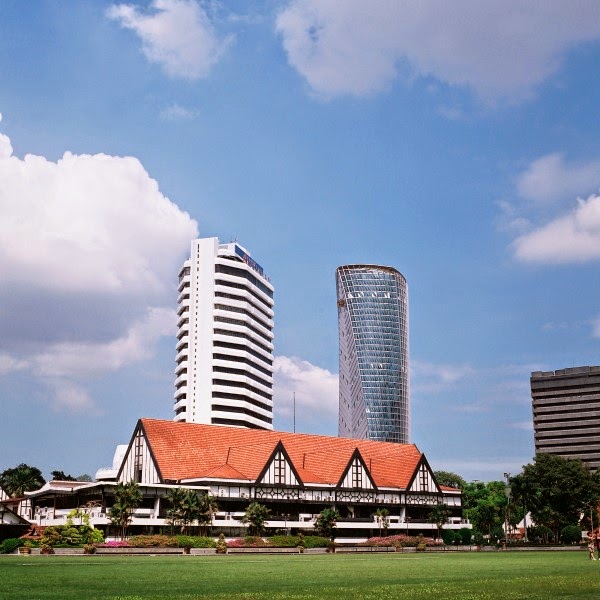
Images from the City Centre (II)
1. Golden.
2. Big brother.
3. Architecture.
4. Bridge.
5.
6.
Question: which camera would you choose if you want something portable, easy to shoot with, medium format quality, and with a lens that is slightly wider than normal?
Answer: Fuji GS645S. Medium format rangefinder with 60mm lens, fully mechanical with coupled meter. Ticks every box.
The Fuji GS645S, released in 1984, is a follow-up of the Fuji GS645 (without "S") released a year earlier. This GS645S can be identified by its distinctive crash bar around the lens, likely due to its inherent design weakness as it is based on the folder design (read: fragile) of the GS645. It sports an excellent 7-element Fujinon 60mm lens, which in 35mm format is equivalent to about 38mm. Shooting a rangefinder is much easier than an SLR in medium format world due to SLR's large flippin' mirror causing significant vibration. Rangefinder design allows handheld shooting at slow shutter speeds which is impossible for medium format SLRs. Also, with the coupled light meter, shooting with this camera is easy as there is no need for eye metering or carrying a light meter. In terms of portability, SLRs in 645 format are all modular systems (like my Bronica ETRS, Mamiya 645 series etc), thus making them very bulky. For 645 format rangefinders, there is the Fuji's and an alternative would be the excellent Bronica RF645 system, however that costs quite a bit more compared to the Fuji's.
Now, nothing is perfect, and this is especially true for Fuji rangefinders from the 80's. The most important thing is they are notorious for being fragile cameras and requires some babying and care. The materials used just do not give confidence, and the design is based on the GS645's folder design, which meant that there wasn't a rigid, solid structure to mount the lens where the GS645's lens used to be- thus requiring protective crash bars around the lens. A quick play with it will tell you the weak point of the camera, and by all means, avoid hitting the camera against anything because it feels like it will just fall apart. Another way to destroy the camera is to catch something with the semicircular crash bar around the lens- that will probably rip the camera apart like committing seppuku (切腹).
All being said, the Fuji GS645S is a wonderful camera, with a beautiful, well-designed 7-element 60mm lens (Fujinon lenses have quite a reputation) in a fully mechanical body, complete with an easy to use coupled meter. The rangefinder design allows better portability and a wider shooting envelope, which enhances its appeal. Definitely look forward to shoot more with this camera!
LY.
Images from the City Centre (I)
1. Flag.
2. Yellow windows.
3. Getting grumpy.
4. Construction site.
5. Pillars.
6. National electrical company.
Finally, exams are over. Back to photography then! My friend and I are going to publish our collaborative blog soon- stay tuned.
LY.
2. Yellow windows.
3. Getting grumpy.
4. Construction site.
5. Pillars.
6. National electrical company.
Finally, exams are over. Back to photography then! My friend and I are going to publish our collaborative blog soon- stay tuned.
LY.
2013 Cradle Mountain. 2
1.
2.
3.
4.
5.
6.
7.
8.
Cradle Mountain National Park is, without doubt, one of the most beautiful place that I've been. Standing beside the river & listening to the water flowing is so tranquillising and makes one feel connected to nature. I felt completely absorbed into the beautiful surroundings and were totally focused on shooting- it's just so beautiful, there's so many places to explore and so many angles to shoot from.
The nice little hut you see here is the Blandfordia Alpine Club hut, by one of my friend's bushwalking club. This primitive yet lovely hut is quite an eye-opener for me, since I'm a total city boy. I learned how to chop wood, start a fire, control the heat, prevent possums from stealing your food, and keeping the beers cold. And it was fun solving the jigsaw puzzle...
~
It's regretful that I have not been updating this blog as much as I should, but I should start sharing my photos again, since I have more than 40 rolls of film waiting for me. Over my holidays last year I also did a photo project with fellow photographer Hao Ran Lai, and we will share the result of our collaboration soon. =)
As for now, I hope you enjoy my photos of Cradle Mountain.
Thanks for reading.
Film | 2013 Cradle Mountain. 2
Bronica ETRS, Fujifilm Reala 100.
First Shoot: Bronica ETRS (III)
1.
2.
3.
4.
Two very different kinds of photography, action & landscape.
Obviously, this camera, without the motor drive/ vertical grip isn't made for action shots. Also, the focusing is geared for precision rather than speed: the distance scale is spread wide apart, which means that focus can be set accurately, but requires a long throw. I suppose this is necessary in medium format as any slight focusing error will be quite obvious when enlarged.
Thanks for reading.
Film | First Shoot: Bronica ETRS (III)
Bronica ETRS, Fujifilm Reala 100
First Shoot: Bronica ETRS (II)
1.
2.
3.
4.
Perhaps the only problem I have with the Bronica is the lack of... chemistry. The bond, connection. The X factor that makes me wanna pick it up over and over again everytime I go shooting. Of course, it's not the only camera that I couldn't connect with: my Olympus OM-2N is also another such camera, same as my Minolta Hi-Matic 7s. Perhaps I could learn to love the cameras, or maybe it would grow on me- but not now. Perhaps it's due to the 'feel' or ergonomics of the cameras, I'm not sure. However, the "professionalism" of this Bronica is amazing, sometimes it leaves me in awe because it's just so capable, it feels like it could take on a good beating- or be used as a weapon itself.
Thanks for reading.
Film | First Shoot: Bronica ETRS (II)
Bronica ETRS, Fujifilm Reala 100, Kodak Portra 400
First Shoot: Bronica ETRS (I)
1.
2.
3.
4.
When I first received my Bronica ETRS, it was as I expected: big, heavy and clunky in operation. The lens mount is so massive it fills the entire front façade; the mirror slap feels like it can flip the camera over; the lens is huge and heavy; the film back is interchangeable etc. Professional features are everywhere in this camera, it is evident that it has been well thought out and designed for professionals. For instance, the mount on the lens has 4 special small separations/ grooves for each bayonet claw- to negotiate the effect of thermal expansion and contraction (similar to railway tracks). The port for the threaded cable release is not on the shutter button like most 35mm cameras but on the side of the camera body- probably to prevent mechanical blockage of the cable release to the lenses. The lenses all have leaf shutter, which means that flash can sync at all speeds. It's easy to see why this is the wedding photographers' choice of camera, along with the Mamiya 645 (in the good old days anyway).
Thanks for reading.
Film | First Shoot: Bronica ETRS (I)
Bronica ETRS, Fujifilm Reala 100, Kodak Portra 400
Life Scenes (VI): Friends
Amigos para siempre.
Thanks for reading.
Film | Life Scenes (VI): Friends
Yashica Mat-124G, Fujifilm Reala 100, Kodak Portra 400
Life Scenes (IV): Extinction of Life
One life ends, another begins. And the world goes round and round.
Thanks for reading.
Film | Life Scenes (IV): Extinction of Life
Yashica Mat-124G, Fujifilm Reala 100
Subscribe to:
Posts (Atom)
.jpg)


+(Custom).jpg)
.jpg)
+(Custom).jpg)
+(Custom).jpg)
.jpg)
+(Custom).jpg)


.jpg)
.jpg)
.jpg)
.jpg)


.jpg)
.jpg)
.jpg)